
Which Seat-Cover Material Suits a Hot 2024 Tacoma—and Which Seats Can Use It?
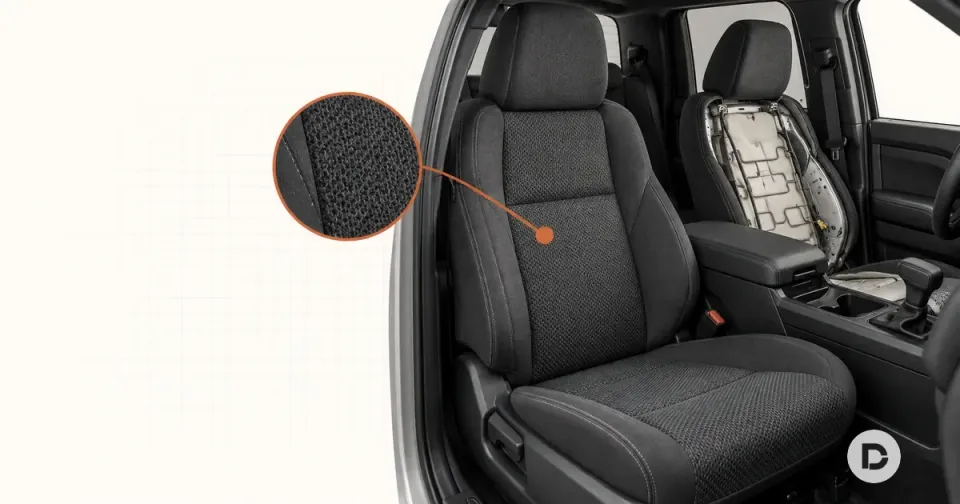
CHOOSE BREATHABLE ONLY AFTER THE PASSENGER-SEAT SAFETY CHECK
For a 2024 Tacoma used in heat and humidity, a breathable polycotton cover is a sensible material to investigate—but only in a pattern listed for the exact trim, cab and seat layout. Do not put a cover over the front-passenger seat cushion: Toyota specifically warns against seat covers there because they can affect passenger occupant classification. A manufacturer’s airbag-compatible claim does not replace that Toyota instruction.
Fit Assistant · For your setup
Choose protection for your seats
Tell us a little about your situation. Fit Assistant will help you apply this guide.
Seat-position snapshot
| Seat/cover decision | Verdict | Required check |
|---|---|---|
| Front-passenger cushion cover | Do not use | Toyota warns it can affect occupant classification and airbag operation. |
| Driver or rear-seat vehicle-specific breathable cover | Possible candidate | Match trim, cab, row, seat layout and heated/ventilated features. |
| Universal cover or generic “airbag compatible” claim | Not enough evidence | Do not let it override Toyota's seat-position restriction. |
| Material choice before safety/fitment selection | Wrong sequence | Establish allowed seat position and exact pattern first. |
The material choice is secondary to the seat position
“Breathable” is a useful requirement in a hot, humid cabin, but it is not a fitment or safety approval. Covercraft describes its polycotton SeatSaver fabric as breathable and specifically useful for people working in heat. Its 2024 Tacoma catalogue also lists the Tacoma trims it serves. That makes a vehicle-specific polycotton pattern a reasonable product category to research—not a blanket approval for every front seat. See Covercraft’s 2024 Tacoma SeatSaver catalogue.
Toyota’s front-passenger restriction controls the decision
Toyota’s 2024 Tacoma manual says not to use a seat accessory, including a cushion or seat cover, that covers the front-passenger seat-cushion surface. The manual ties that instruction to the passenger occupant-classification system and warns that improper use can prevent the relevant airbags from activating. This is a reason to leave that cushion uncovered even if a cover maker describes a design as airbag-compatible. Read Toyota’s passenger-occupant-classification precautions.
Use a vehicle-specific listing for any remaining position
For a driver or rear-seat cover, do not infer fitment from a universal material description. Confirm the model year, trim, cab, seat-row and seat features in the cover maker’s vehicle selector; a 2024 Tacoma has trim and seat-layout variation. Covercraft’s 2024 catalogue names SR, SR5, TRD Sport, TRD Off-Road, Limited, TRD Pro, Trailhunter and TRD PreRunner, but the final pattern must still match the selected seat configuration. Check the 2024 Tacoma vehicle catalogue.
What remains unknown
These sources do not establish which material feels coolest for every driver, nor do they approve a front-passenger cushion cover. They also do not substitute for the cover maker’s current configuration selector. If a listing cannot identify the exact seat row and features, skip it rather than treating a generic “Tacoma” label as proof.
Match the material to what happens after a hot trip
Only compare a material for a seating position and application that clears the vehicle's instructions first. A breathable material or a seller's airbag claim does not remove Toyota's front-passenger-cushion restriction.
| Your practical problem | Question to ask after the safety check | What the material label does not prove |
|---|---|---|
| Heat and humidity during daily use | How does this specific fabric breathe and dry? | That the installed seat will stay cool |
| Wet or muddy clothing | How is this exact cover cleaned and dried? | That moisture cannot remain underneath |
| Frequent family cleanup | Can it be removed and washed as instructed? | That every seat position is approved |
| Heated or ventilated equipment | Is that exact seat function covered by the application? | That “custom fit” preserves the function |
Do not buy a front-and-rear bundle before checking each position
A rear-seat protection goal does not require covering the front-passenger cushion. Ask what can be bought separately and what the exact instructions permit. If the application is unresolved, investigate vehicle-approved cleaning and protection choices instead of accepting an ambiguous bundle.
When asking a seller, include the year, cab, trim, seat position and relevant heating/ventilation equipment. “Fits Tacoma” is too broad. Do not attach a protector, strap or storage piece across restraint-system equipment to make an unsuitable product work.
Bottom line
For a hot, humid 2024 Tacoma, begin with breathable polycotton only for a vehicle-specific pattern and an allowed seating position. The direct safety answer is firmer: leave the front-passenger cushion uncovered. For why seat-related warning systems cannot be bypassed casually, see the 2023 Tacoma seat-replacement and SRS guide.
Sources & notes
- Toyota 2024 Tacoma front-passenger occupant-classification precautions, accessed 2026-09-05. Primary vehicle guidance: it specifically warns against a seat cover on the front-passenger cushion surface; it does not approve covers for other seating positions.
- Covercraft 2024 Tacoma SeatSaver catalogue, accessed 2026-09-05. Manufacturer documentation for the material’s breathability and the 2024 Tacoma trims in its catalogue; exact seat configuration still has to be selected.
- Covercraft 2024 Tacoma seat-cover vehicle catalogue, accessed 2026-09-05. Manufacturer catalogue that identifies the 2024 Tacoma trims and describes its tear-away airbag seams; that claim does not override Toyota’s passenger-seat instruction.