
Does a J&L Catch Can Make Sense for Your Tacoma?
DECIDE WHETHER THE EXTRA UPKEEP SOLVES A NEED
A J&L catch can is an optional oil-separator purchase, not a proven engine-life upgrade for every Tacoma. Match the exact engine kit, understand its installation and added servicing, and check the listing’s emissions status before ordering. J&L’s 3104D names the 2016–2023 3.5L Tacoma and is listed as not CARB exempt. Collected material alone does not prove horsepower, fuel-economy or longevity gains.
Fit Assistant · For your setup
Apply this to your oil-separator choice
Tell us a little about your situation. Fit Assistant will help you apply this guide.
What problem would it solve for you?
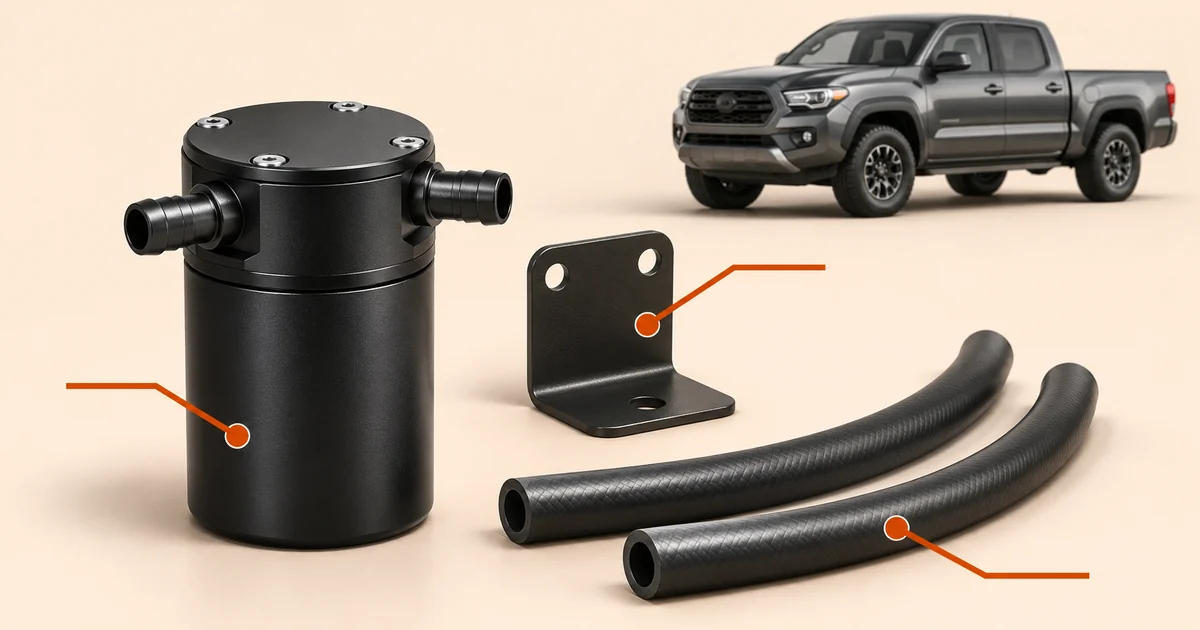
A catch can separates some material from crankcase ventilation flow before that flow returns to the intake path. That describes the accessory’s function; it does not show that a healthy truck needs one.
| Your reason for looking | Useful next step |
|---|---|
| No problem; saw material collected in a review | Compare optional benefit with upkeep and current restrictions |
| Recurring smoke or unusual oil use | Diagnose the actual cause before buying an accessory |
| A modified engine with a documented need | Use the exact builder and separator application |
| Wants guaranteed longer engine life | The reviewed evidence does not establish that promise |
Keeping a properly functioning stock system is a valid outcome. Routine maintenance and investigating a real symptom should not be displaced by an appealing accessory photograph.
Which J&L kit is actually documented?
| Kit | Named Tacoma application | Do not assume |
|---|---|---|
| 3104D | 2016–2023, 3.5L | Same fit on 2.7L, 4.0L or 2024+ engines |
| 3107D | 2005–2015, 4.0L, in its instructions | Same hose/bracket arrangement as 3104D |
| Generic or universal separator | Component lead only | Vehicle-specific fit from can dimensions |
Sources: 3104D listing, 3104D instructions and 3107D instructions.
Match the current selected kit to the actual engine, nearby modifications and instructions. A reused product URL containing older years is not a substitute for the application table displayed on the page.
Does “plug-and-play” mean no alteration?
For 3104D, the exact instructions call for cutting the stock PCV hose. That matters if you expect an entirely untouched factory hose or want to price a future return to stock.
Read the selected manual before ordering. Include the prescribed parts, installation work and checks for interference in the quote. Do not let a broad installation headline replace the kit-specific requirements.
This guide does not provide a hose-cutting recipe or diagnose a PCV fault. Its purpose is to make the purchase and maintenance commitment clear.
What does the emissions listing mean for the order?
The reviewed 3104D product page explicitly says NOT CARB EXEMPT. Do not infer an exemption or permission for your vehicle/use from a Tacoma fit listing, another owner’s installation or a seller calling it a simple accessory.
If an emissions approval is required for your intended use, ask for the applicable current documentation before purchase. This guide does not establish that approval or make a blanket legal determination for every jurisdiction.
Fit and emissions status answer separate questions. A component can have a named physical application without having the approval you need to use it.
How often would you need to check it?
The product FAQ suggests an initial check after 500–1,000 miles to learn the collection rate, with more frequent attention in cold weather because of condensation. The listed capacity is three ounces. That is a starting inspection recommendation, not a promise that every truck can wait until the next oil change.
Follow the current kit’s instructions and actual collection rate. Emptying the reservoir and cleaning the separator are different maintenance tasks; do not substitute a general cleaning interval for a reservoir check or transfer a different kit’s schedule.
Consider access while buying. Can the owner or servicing shop reach the reservoir normally, and will the task remain on the maintenance list? An accessory that adds an ignored service need can be a poor match even if installation is straightforward.
What does material in the can prove?
It shows collection in that vehicle under those conditions. It does not measure how much engine wear was avoided, establish a horsepower gain or predict future reliability.
Climate, use, engine condition and service history can differ. Comparing one owner’s first and later collections is not a controlled comparison with a stock vehicle. Keep the observation useful without converting it into a guaranteed outcome.
Two practical decisions
2022 3.5L, healthy truck, cold winters: weigh the optional accessory against emissions requirements, hose alteration and more frequent checks. “I will inspect it only every 5,000 miles” is not established by the maker’s initial-check advice.
Truck already has smoke or oil-use symptoms: begin with diagnosis. A can may be discussed after the actual cause and suitable application are known; captured liquid alone does not diagnose the problem.
Compatibility snapshot
| Product or claim | Result | Required check |
|---|---|---|
| 3104D on listed 3.5L years | Documented candidate | Exact kit and current instructions · 3104D listing · 3104D instructions |
| 3107D transferred to 3.5L | Different documented application | Use the correct engine kit · 3104D instructions · 3107D instructions |
| 3104D has CARB exemption | Contrary to reviewed listing | Current applicable documentation · 3104D listing |
| Captured material proves longer life | Not established | Do not treat observation as outcome data · 3104D listing |
Before you buy
Finish with a clear reason for adding the separator, a suitable order and an upkeep plan you will follow. The third-generation oil-service guide helps keep normal maintenance in view.
Sources & notes
Reviewed 7 November 2026. J&L’s 3104D product and FAQ, 3104D manual and 3107D manual. No original emissions, engine-wear or performance testing is claimed. See our methodology.