
Which Roof Rack Can You Put on Your Tacoma Camper Shell?
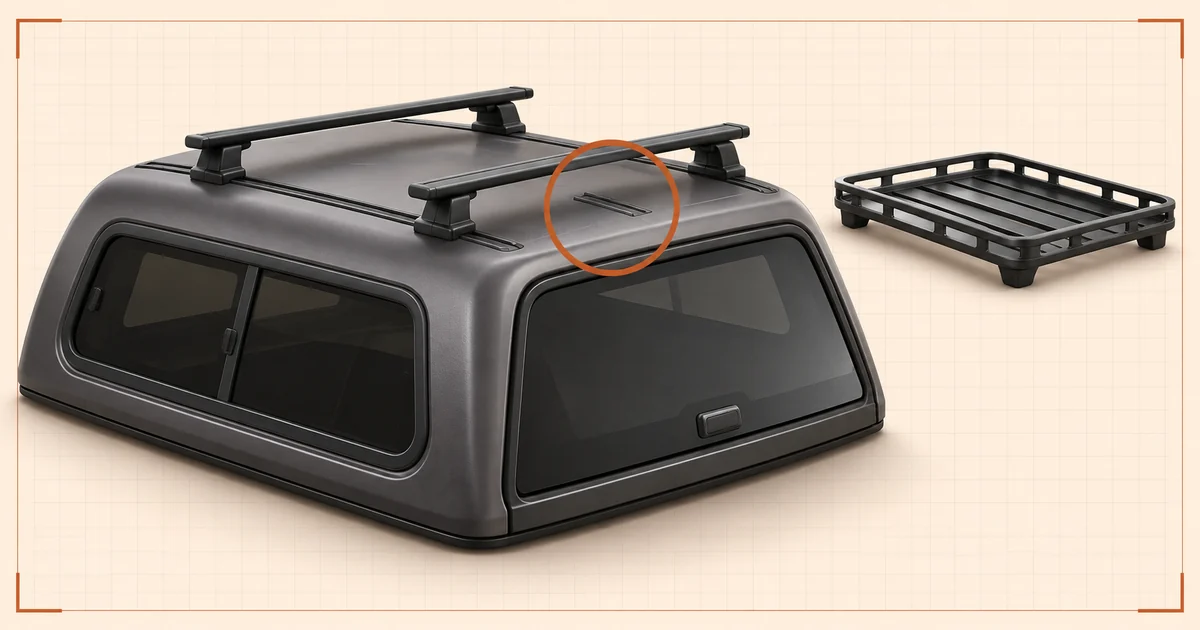
START WITH THE CAP AND ITS MOUNTS, THEN CHOOSE THE RACK
Choose a Tacoma camper-shell rack by the exact cap model, its approved mounting provisions and what you want to carry. Existing tracks may support a documented crossbar system; a smooth roof needs a cap-approved installation route first. The Tacoma's year or cab-roof fitment alone cannot establish what mounts to the shell, and a rack rating does not establish the cap's capacity.
Fit Assistant · For your setup
Choose a rack route for your camper shell
Tell us a little about your situation. Fit Assistant will help you apply this guide.
Is this a rack for the cab roof or the camper shell?
A cab-roof rack attaches to the truck's roof. A camper-shell rack attaches to a separate enclosure over the bed. They have different structure, mounts, shape and load documentation, even when the two roofs look nearly level.
Use the Tacoma cab-roof rack comparison if you mean the roof above the passengers. This guide answers the separate cap-mounted question. If the enclosure itself is still undecided, choose the shell or topper before assuming a rack can be added later.
What is already on the cap roof?
| What you have | Useful next step | What not to assume |
|---|---|---|
| Identified manufacturer tracks | Compare the rack maker's supported pad/tower/bar system | Every T-shaped channel takes the same feet |
| Named factory rack or fixed points | Use the cap's exact approved rack/application instructions | A similar-looking attachment has the same rating |
| Smooth fiberglass roof | Ask the cap maker and authorized installer about an approved retrofit | A generic drilling pattern suits the shell |
| Metal or modular cap | Start with that cap's own rail, mount and rack documentation | A fiberglass-cap recipe transfers automatically |
| Used cap with unknown tracks | Find the cap identification and original rack information | A track photo establishes its structure or capacity |
Ask for the cap model, build information and any original rack paperwork. Unknown details do not stop you learning the choices; they do stop a final purchase approval.
Which documented crossbar routes are worth understanding?
Yakima's current custom-solutions page separates fiberglass camper shells from metal vehicle roofs. Its fiberglass route includes tracks with CapNuts, Landing Pad 1 with SkyLine towers or a TrackTower route, and selected crossbars. Its HD-track route names different hardware choices. Review the fiberglass-shell section.
That is a useful parts-system example, not approval to drill any cap. The cap structure, installation and exact products still need confirmation. Do not substitute the metal-roof PlusNut instructions because they appear on the same page.
Yakima's SkyLine system also makes clear that pads and bar adapters are part of the system. Buying crossbars alone can leave out the parts that actually connect them to the roof. Identify existing tracks before ordering feet that merely look similar.
When are two crossbars enough?
Crossbars are a useful starting point when a documented carrier supports the cargo you want to carry—such as kayaks or a roof box—and its required bar shape and spacing work on the cap. Compare the carrier's mounting instructions as well as the bars.
For example, two kayaks raise questions about their carriers, usable bar width, loading access and the complete carried weight. A roof box raises different questions about clamp spacing and hatch access. Choose the support around that actual job rather than automatically buying a full-length platform.
Tracks may allow bar-position adjustment within the documented installation, while fixed points constrain the positions. That difference can matter when a carrier requires a particular spread. Adjustment is still limited by the approved system; it is not permission to place bars anywhere on the shell.
When does a platform make sense?
Compare a platform when its mounting flexibility solves a real equipment problem: several documented mounts, awkward-shaped equipment or a layout that works better on a continuous rack surface. Include the platform, feet, adapters and carriers in both the price and weight comparison.
A platform does not make a cap stronger. It can also change access to the rear hatch, roof clearance and overall height. Check the supported attachment and clearance across the curved roof rather than buying only by the platform's outside dimensions.
If a simple carrier on crossbars does the job, a larger platform may add equipment and upkeep without making the routine easier. If several items need to be organized together, it can be worth comparing—within an approved cap/rack application.
Which load limit should you use?
Read the cap's documentation and the instructions for every part of the proposed system: tracks or mounts, towers/feet, bars or platform, and the cargo carrier. Keep the operating condition attached to each limit, including any on-road, off-road or static distinction. Do not combine ratings that describe different conditions.
LEER supplies a concrete reason to ask about the exact factory system. Its FAQ lists different capacities for Thule AeroBlade and Tracker II systems when factory-installed on specifically named LEER models. That is not one universal LEER-cap or aftermarket-rack rating. Read LEER's exact model and rack qualifications.
Include rack and carrier weight when the applicable instructions require it, not just the gear placed above them. If the documents do not establish a complete supported combination, ask the cap and rack makers to resolve it. A high number on a bar page does not fill in an unknown cap rating.
Can you put a rooftop tent on it?
Treat a tent as a separate application, not as ordinary cargo that happens to fit the bars. Obtain explicit cap, mounting-system, rack and tent support for the actual setup and operating conditions. Occupied static use is a different question from carrying the folded tent while driving.
The Tacoma roof-load guide explains the rating terms. Its cab-roof discussion does not approve a camper shell. Neither a photo of someone else's tent nor a parked-person demonstration establishes the missing application evidence.
What should an installer quote include?
Ask for the approved roof/track preparation, complete mounting hardware, bars or platform, required adapters, carrier and installation. Confirm sealing, inspections, maintenance and warranty conditions before approving a retrofit. Do not drill first and search for the right system afterward.
Check the hatch and other openings through their full travel, roof-to-rack clearance and the truck's overall height with the chosen load. LEER's FAQ explicitly reminds owners that overall vehicle height also depends on the truck setup. A nominal cap height is not your final garage-clearance measurement.
Compatibility snapshot
| Proposed route | What the source establishes | Required check |
|---|---|---|
| Yakima fiberglass-shell track route | A named CapNut/track/tower/bar system to investigate | Cap approval, exact components and installation |
| Existing unknown tracks with generic feet | No complete application | Identify tracks and supported attachments first |
| LEER factory Thule system on a named cap | Rack/model-specific manufacturer information | Actual cap, rack version, instructions and operating limits |
| Any platform or rooftop tent on a smooth/unidentified cap | No generic structural or load approval | Written support for the complete application |
Before you buy
- Identify the actual cap, not just the Tacoma year and bed length.
- Record existing tracks or approved mounting provisions.
- Choose the cargo carrier and support style around your routine.
- Confirm all applicable mounts, load conditions and clearances.
- Compare the complete quote and preserve the installation/use instructions.
Browse Tacoma Guides and roof racks and lighting for related decisions.
Bottom line
The cap determines the mounting question; the cargo determines the useful rack. Start with an approved route, then compare crossbars and a platform around access, weight and use. Resolve missing mounting or load information with the makers before ordering.
Sources & notes
- Yakima custom roof-rack solutions, checked 2026-11-05, fiberglass camper-shell section. Named track/mount routes and application-specific limits; metal-roof instructions are a separate section.
- Yakima SkyLine system, checked 2026-11-05. Pad/tower/bar system and adapter qualifications, not a generic cap approval.
- LEER FAQ, checked 2026-11-05. Specific factory Thule/LEER-model qualifications and overall-height guidance; no universal static/tent/off-road rating inferred.
- Original generic shell/rack illustration; it does not depict a named compatible product, structural reinforcement or load approval. This is a documentation-based buying guide, not a drilling, installation or load-test report.